

Essential Screening Criteria and Standards for Evaluating Tenant Applications
Property owners and managers face a critical decision point with every new applicant. The cost of a bad tenant far exceeds the administrative effort of a rigorous screening process. According to recent industry data, approximately 25% of rental properties experience at least one eviction case during a tenancy, with average legal costs reaching thousands of dollars per incident. This statistic underscores why standardized screening is not optional but a fundamental risk management tool. By implementing strict, legally compliant criteria, landlords protect their assets and ensure a stable rental income stream.
Credit and Income Verification Standards
The financial stability of an applicant is the strongest predictor of lease compliance. Landlords must establish clear thresholds for income and creditworthiness before reviewing any application. The standard industry rule is that gross monthly income should be at least three times the monthly rent. This ratio ensures that tenants have sufficient funds for other living expenses while maintaining timely rent payments.
Credit reports provide a detailed snapshot of financial responsibility. A credit score below 620 often signals high risk, though this is not an automatic disqualification. Instead, it requires deeper investigation into the applicant's financial history. Look for patterns of late payments, high credit utilization, or recent bankruptcies. Conversely, a score above 700 typically indicates a low-risk candidate who has managed debt responsibly.
Income verification goes beyond pay stubs. Landlords should request recent bank statements or direct deposit records to confirm consistency. Self-employed applicants require additional scrutiny, such as tax returns from the past two years. This thorough approach prevents income inflation and ensures the applicant can sustain the lease long-term. For more insights on financial vetting, investopedia outlines the rationale behind the three-times-rent standard.
Criminal History and Background Checks
Background checks are essential for community safety but must be applied with precision and fairness. The goal is to identify risks that threaten the physical safety of other residents or the integrity of the property. However, blanket bans on all criminal records are legally problematic and often ineffective.
Focus on recent, serious offenses rather than minor infractions from years ago. Violent crimes, drug trafficking, and property destruction are primary red flags. Non-violent misdemeanors, especially those older than five to seven years, may not predict future behavior. The Department of Housing and Urban Development (HUD) has issued guidance stating that blanket bans on criminal records can have a disparate impact on protected classes. Therefore, individualized assessments are crucial for compliance.
When reviewing background reports, look for consistency in the data. Discrepancies between the application and the background check may indicate dishonesty. For example, if an applicant lists a current address that does not match the background check, it warrants further inquiry. Understanding these nuances helps landlords make informed decisions. HUD FAQs clarify the legal boundaries of criminal screening.
Rental History and Reference Checks
Past behavior is the best predictor of future performance in tenancy. Contacting previous landlords provides qualitative data that credit scores cannot. Ask specific questions about payment timeliness, property care, and lease adherence. Did the tenant pay rent on time? Were there any complaints about noise or disturbances? Did they leave the property in good condition?
Direct communication with former landlords is more reliable than automated reference services. Many applicants may provide fake references or friends who will not give an honest assessment. Verify the landlord's identity and their relationship to the applicant. If a previous landlord is unreachable, note this in the application file. It may indicate a lack of transparency or a problematic departure.
Look for patterns of positive tenancy. A history of long-term leases with no issues is a strong indicator of reliability. Conversely, frequent moves or early lease terminations suggest instability. For a deeper dive into reference strategies, NARPM offers detailed best practices for property managers.
Legal Compliance and Fair Housing
Screening criteria must be applied uniformly to all applicants to avoid discrimination claims. Fair Housing laws protect applicants based on race, color, religion, national origin, sex, familial status, and disability. Any criterion that disproportionately affects a protected class must be justified by business necessity.
Document your screening process meticulously. Keep records of all applications, credit reports, and decision-making notes. This documentation is vital if a discrimination claim arises. It proves that decisions were based on objective data, not bias. Consistency is key. Apply the same income requirements, credit score thresholds, and criminal history policies to every applicant.
Stay updated on local and state laws. Some jurisdictions have additional restrictions, such as limiting the look-back period for criminal records or capping application fees. Ignorance of these laws can lead to costly legal penalties. For comprehensive legal updates, Nolo provides accessible explanations of federal and state regulations.
Decision-Making Frameworks
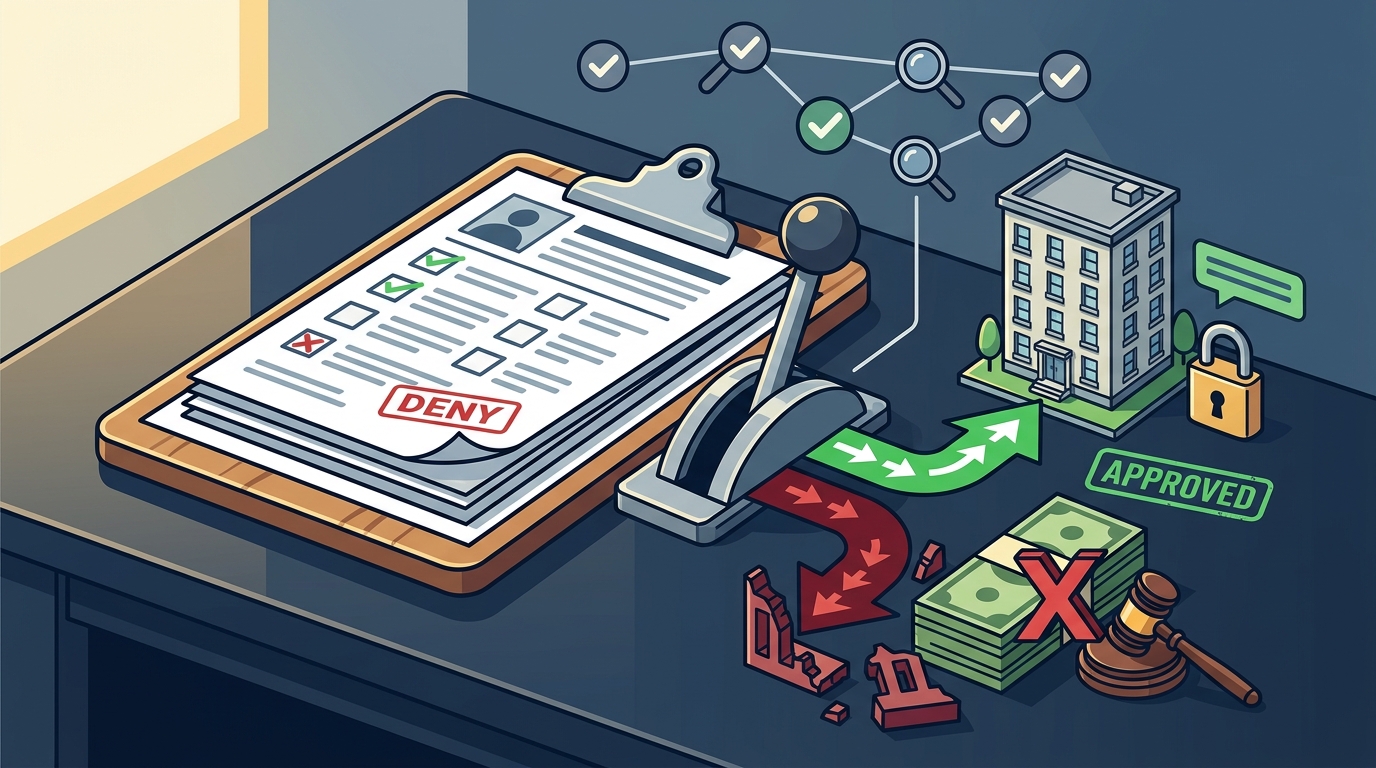
Creating a standardized scoring system reduces subjectivity and speeds up the approval process. Assign points for positive factors, such as high credit scores and long rental history. Deduct points for negative factors, such as late payments or evictions. Set a minimum score for approval. This framework ensures that every applicant is evaluated against the same benchmark.
Consider the overall profile of the applicant. A slightly lower credit score may be acceptable if the applicant has a strong co-signer or a large security deposit. Conversely, a high credit score does not excuse a history of property damage. Balance quantitative data with qualitative insights from references.
Use technology to streamline the process. Automated screening tools can aggregate data from multiple sources, providing a comprehensive view of the applicant. These tools often include compliance checks to ensure adherence to Fair Housing laws. For efficient screening solutions, 2Verifi offers advanced tenant screening services designed for accuracy and speed.
Key Takeaways
- Income Verification: Require gross monthly income of at least three times the rent to ensure financial stability.
- Credit Thresholds: Use a credit score of 620 as a baseline, but investigate scores below this threshold.
- Criminal Screening: Conduct individualized assessments rather than blanket bans to comply with HUD guidelines.
- Reference Checks: Contact previous landlords directly to verify payment history and property care.
- Fair Housing: Apply all criteria uniformly to avoid discrimination claims and legal penalties.
- Documentation: Keep detailed records of all screening steps to defend against potential disputes.
- Automated Tools: Leverage technology like 2Verifi to streamline data aggregation and compliance checks.
Frequently Asked Questions
What is the standard credit score requirement for tenants?
While there is no universal standard, a credit score of 620 or higher is commonly required. Scores below this may indicate higher risk and require additional scrutiny or a co-signer.
How far back should criminal background checks go?
Most experts recommend a seven-year look-back period. However, some states have no limit, while others restrict the scope of what can be considered. Always check local laws.
Can I deny an applicant based on a criminal record?
You can deny an applicant based on criminal history, but you must conduct an individualized assessment. Blanket bans are often considered discriminatory under Fair Housing guidelines.
What documents are needed for income verification?
Typically, landlords request recent pay stubs, bank statements, and tax returns for self-employed individuals. These documents prove the applicant's ability to pay rent consistently.
How do I handle a tenant with no credit history?
For applicants with no credit history, rely more heavily on rental references and income verification. A larger security deposit or a co-signer may also be appropriate.
What is the difference between a credit check and a background check?
A credit check assesses financial responsibility and debt management. A background check includes criminal history, eviction records, and sometimes employment verification.
How long does the tenant screening process take?
With automated tools, screening can be completed in minutes. Manual verification may take several days. Prompt processing improves the applicant experience and secures good tenants faster.
Secure Your Property with Professional Screening
Evaluating tenant applications is a complex task that requires attention to detail and strict adherence to legal standards. By implementing robust screening criteria, you protect your investment and maintain a safe community. Do not leave your property's future to chance. Partner with experts who understand the nuances of tenant vetting. Visit 2Verifi.com to learn how our comprehensive screening services can streamline your process and provide peace of mind.